
 CALL US NOW
 EMAIL US NOW
A strong bed bug injury claim usually requires evidence proving where the exposure occurred, that bed bugs were present, who controlled the property, whether the responsible party knew or should have known about the infestation, and what injuries and losses resulted. Helpful evidence may include photographs, videos, medical records, booking confirmations, written complaints, incident reports, pest-control records, witness statements, receipts, and proof of prior infestation problems.
Building a successful bed bug injury claim requires more than showing that bites appeared after a hotel stay, cruise, rental, or other property visit. The evidence must connect the infestation to a specific location, identify who controlled the property, and show that the responsible party knew, or reasonably should have known, about the problem and failed to address it appropriately.
The strongest claims are supported by a combination of photographs, videos, medical records, booking confirmations, written complaints, incident reports, pest-control documentation, witness statements, receipts, and evidence of earlier infestation complaints. Together, these materials help establish exposure, negligence, injuries, and the full financial and personal impact of the incident.
No single photograph, bite, or complaint guarantees a successful outcome. Bed bug claims are evidence-driven, and the strength of the complete timeline usually matters more than any one piece of proof.
Key Takeaways
- Photograph and video the bites, room, mattress, furniture, luggage, and visible infestation signs.
- Immediately report the infestation in writing and request a copy of any incident report. If one is not provided, get the name of who you reported it to.
- Seek prompt medical care and continue documenting symptoms as they develop.
- Preserve booking records, receipts, damaged belongings, and communications with the property.
- Evidence that the business received earlier complaints can be critical to proving notice.
- Do not discard infested items or accept a settlement before understanding the full value of the claim.
Why Evidence Is So Important in a Bed Bug Injury Claim
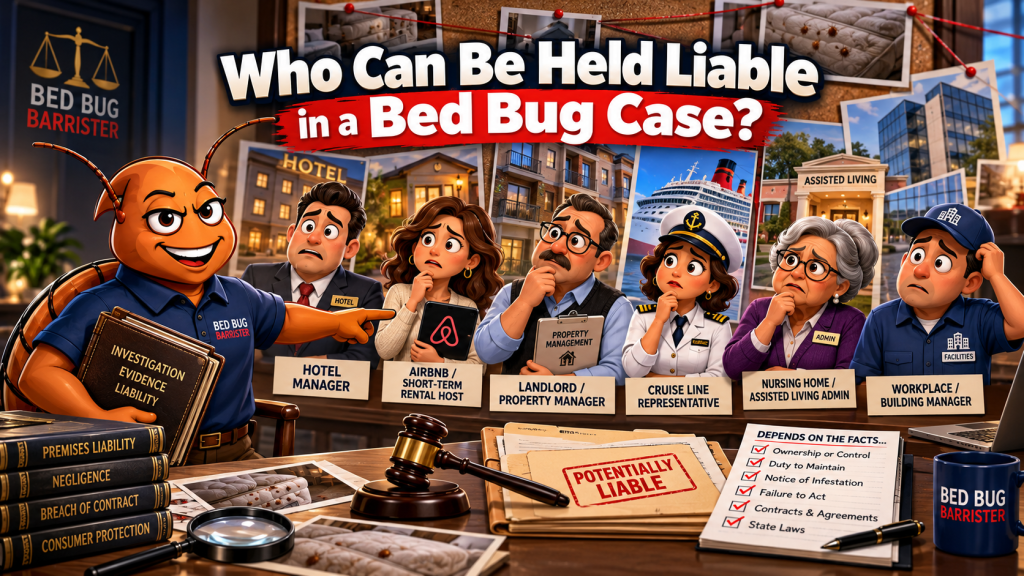
Discovering bed bugs does not automatically prove that a hotel, resort, cruise line, rental operator, nursing home, employer, or other property owner was negligent. A claimant generally must connect the infestation and resulting injuries to a party that had a legal responsibility to inspect, maintain, or respond to conditions at the property.
The evidence should help establish several important parts of the claim:
- Bed bugs were present at the property.
- The claimant was exposed there.
- The defendant controlled or maintained the affected area.
- The defendant knew or reasonably should have known about the problem.
- The response to the infestation was inadequate or unreasonably delayed.
- The exposure caused identifiable injuries and financial losses.
Bed bug cases often become difficult when one of these links is missing. Collecting evidence immediately can create a clear, consistent account before the room is cleaned, records are lost, or the defendant begins disputing what happened.
Photographs and Videos of the Infestation
Photographs and videos can provide some of the most persuasive early evidence in a bed bug case. They may document conditions that no longer exist by the time an attorney, insurance adjuster, inspector, or expert becomes involved.
Do not photograph only the bites. The Environmental Protection Agency explains that skin reactions alone are a poor indicator of an infestation because bed bug bites can resemble mosquito bites, other insect bites, eczema, fungal conditions, or hives. More reliable infestation indicators include live bugs, reddish stains, dark fecal spots, eggs, eggshells, and skin sheddings.
What Should You Photograph?
Create both close-up and wide-angle images showing:
- Live or dead bed bugs
- Mattress seams and piping
- The box spring and bed frame
- The area behind the headboard
- Upholstered chairs and couches
- Dark fecal marks or reddish stains
- Eggs, eggshells, and shed skins
- The room number or cabin number
- Luggage and personal belongings
- Bites as they change over several days
- Any visible swelling, infection, or scarring
Do not crop or heavily edit the original images. Preserve the original files because their date, time, and location metadata may help support when and where they were taken.
A complete visual record is more useful than one isolated photograph. Images showing both the overall room and the specific infestation evidence help place the discovery in context and reduce disputes about where the evidence came from.
Physical Evidence of Bed Bugs
Physical evidence can strengthen a claim when it is preserved safely and can later be identified by a qualified pest-control professional or entomologist. A specimen may help distinguish an actual bed bug from carpet beetles, fleas, ticks, or other insects that are commonly misidentified.
When possible, avoid crushing or directly handling a suspected bed bug. A specimen may be secured in a sealed container or clear plastic bag.
Potential physical evidence includes:
- A captured live or dead insect
- Skin sheddings
- Eggs or eggshells
- Infested clothing
- Furniture containing visible insects
- Bedding or fabric with stains and fecal spotting
- Pest-control samples or inspection findings
Do not bring loose infested items into another home, office, or vehicle. Photograph the item where it was discovered and obtain professional guidance on containment before moving it.
Physical evidence must also be handled carefully so the defendant cannot argue that it came from another location. Documenting who collected it, when it was collected, and where it was stored can make the evidence substantially more useful.
Written Complaints, Incident Reports, and Communications
A business may deny that an infestation was ever reported unless the complaint exists in writing. Verbal conversations can still matter, but emails, text messages, platform messages, and formal incident reports usually create a stronger record of notice.
Report the problem immediately through every available official channel. For a hotel or resort, notify the front desk and management; for a cruise, contact guest services; and for a short-term rental, communicate through the booking platform as well as directly with the host.
Preserve copies of:
- Incident reports
- Emails and text messages
- Booking-platform messages
- Maintenance requests
- Complaint confirmation numbers
- Names and titles of employees contacted
- Room-change or relocation documents
- Refund, credit, or compensation offers
- Treatment notices
- Responses from management or ownership
Request a copy of the incident report before leaving. When the property refuses to provide one, write down the date, time, name of the person contacted, and the substance of the conversation.
Written communications help establish when the property received notice and what it did afterward. They may also reveal admissions, inconsistent explanations, treatment delays, or attempts to minimize a known problem.
Booking Records and Proof That You Were at the Property
A claim requires proof that the injured person was actually present at the location where the exposure allegedly occurred. Booking confirmations and travel records help establish the dates, room assignment, and parties included in the reservation.
Be sure to preserve:
- Reservation confirmations
- Hotel folios or reservation emails
- Cruise tickets and passenger contracts
- Short-term rental booking records
- Credit card statements
- Check-in and checkout confirmations
- Room or cabin numbers
- Parking receipts
- Flight records
- Photographs taken during the trip
- Location history when available
Travel records become especially important when a person stayed at more than one property. Defendants frequently argue that the claimant encountered bed bugs somewhere else, so a complete itinerary can help address competing explanations.
These records may appear routine, but they form the foundation of the exposure timeline. Without reliable proof of where and when the stay occurred, even compelling bite photographs may be challenged.
Medical Records Connecting the Exposure to Your Injuries
Medical documentation helps establish that the exposure caused genuine physical or psychological harm. It also shows when symptoms began, how they progressed, what treatment was required, and whether complications developed.
The Centers for Disease Control and Prevention notes that reactions can range from no visible signs to itchy marks and, more rarely, serious allergic responses. Scratching may also lead to secondary skin infections, while some people experience insomnia, anxiety, and other stress-related effects.
Useful medical evidence may include:
- Emergency room or urgent care records
- Primary care evaluations
- Dermatology records
- Allergy testing or treatment
- Prescription records
- Antibiotic treatment for infection
- Photographs taken by medical providers
- Scar evaluations
- Mental health counseling records
- Sleep-related treatment
- Follow-up appointments
- Work restrictions or disability notes
Tell the medical provider when and where the suspected exposure occurred, but describe the facts accurately rather than insisting on a diagnosis the provider has not confirmed. Because bite reactions are not uniquely diagnostic of bed bugs, environmental evidence and professional identification are particularly valuable.
Prompt treatment protects both health and legal rights. Continuing care when symptoms persist also prevents defendants from arguing that the injuries must have resolved because no follow-up treatment occurred.
Evidence That the Property Knew or Should Have Known About the Infestation
Proving that bed bugs existed is only part of the case. A successful negligence claim often depends on showing that the responsible party had actual or constructive notice of the condition and failed to respond reasonably.
Actual notice may exist when staff received a previous complaint, observed the infestation, or ordered treatment. Constructive notice may be argued when the infestation existed long enough, or occurred frequently enough, that reasonable inspections and maintenance practices should have discovered it.
Potential notice evidence includes:
- Prior guest or resident complaints
- Pest-control invoices
- Treatment reports
- Housekeeping logs
- Maintenance records
- Room-out-of-service records
- Internal emails
- Inspection schedules
- Employee testimony
- Complaints involving nearby rooms or units
- Repeated online reviews describing similar problems
- Evidence that a room was quickly treated after the incident
Online reviews can provide investigative leads, but they should not be treated as automatically verified proof. An attorney may use them to identify witnesses, dates, patterns, or records that can be pursued through formal investigation.
Notice evidence often separates an unfortunate infestation from actionable negligence. Records showing repeated complaints, inadequate treatment, or continued occupancy of an affected room can substantially change how a claim is evaluated.
Witness Statements and Independent Confirmation
Witnesses can corroborate both the infestation and the property’s response. Their observations may become especially important when the bugs disappeared after treatment or if the staff refuses to prepare a written report.
Potential witnesses include:
- Family members or travel companions
- Other guests
- Neighboring tenants
- Housekeeping employees
- Front-desk personnel
- Maintenance workers
- Pest-control technicians
- Medical providers
- People who observed the bites immediately after the stay
Obtain names, telephone numbers, email addresses, and a brief description of what each person observed. Do not rely solely on social-media connections because accounts can disappear and messages may become difficult to retrieve later.
Independent witnesses can make the account harder to dismiss as a misunderstanding or isolated allegation. A neutral exterminator, employee, or unrelated guest may provide particularly persuasive confirmation.
Receipts and Proof of Financial Losses
A claimant must document not only what happened but also what the infestation costs. Financial evidence helps calculate the measurable portion of damages and prevents expenses from being overlooked during settlement negotiations.
Preserve receipts and records for:
- Medical treatment
- Prescription and over-the-counter medications
- Replacement lodging
- Transportation
- Cleaning and laundry
- Professional extermination
- Luggage replacement
- Clothing or furniture replacement
- Missed excursions or activities
- Lost wages
- Used vacation or sick leave
- Counseling or psychological treatment
Ask an employer for written verification of missed work, reduced hours, or lost income. Self-employed individuals should retain invoices, calendars, tax records, canceled appointments, and other documents showing interrupted earnings.
Small expenses can become significant when combined across weeks or months. Maintaining one organized folder or digital file makes it easier to demonstrate the full financial impact of the infestation.
A Personal Symptom and Recovery Journal
Some consequences of bed bug exposure are difficult to capture in a receipt. A contemporaneous journal can document itching, sleep disruption, embarrassment, anxiety, pain, and limitations on daily activities.
Journal entries may describe:
- When new bites appeared
- Changes in swelling or irritation
- Sleep lost because of itching or fear
- Social activities avoided
- Missed work or school
- Difficulty traveling or staying in hotels
- Emotional distress
- Medical appointments and treatment effects
Keep entries factual, dated, and consistent with the medical records. Avoid exaggeration or language written primarily for litigation, because credibility is essential.
A journal cannot replace professional medical documentation, but it may illustrate how the injuries affected ordinary life between appointments. It can help turn an abstract claim for discomfort or emotional distress into a specific, understandable timeline.
Common Evidence Mistakes That Can Weaken a Claim
Evidence can disappear quickly after a bed bug discovery. A property may treat the room, discard bedding, overwrite surveillance footage, or lose internal records before the injured person realizes those materials could matter.
Common mistakes include:
- Leaving without reporting the infestation
- Taking photographs of bites but not the room
- Failing to seek medical care
- Throwing away luggage or clothing before documenting it
- Communicating only by telephone
- Posting exaggerated claims on social media
- Accepting a refund tied to a release
- Signing a waiver without legal review
- Waiting months to investigate
- Losing booking records and receipts
- Discarding the original photo or video files
- Giving inconsistent accounts of the travel timeline
Do not secretly remove hotel property or create unsafe exposure for others in an effort to preserve proof. The goal is to document evidence lawfully, safely, and in a manner that maintains its reliability.
Many weak claims begin with a real infestation but suffer from missing documentation. A few careful steps at the time of discovery can prevent major proof problems later.
Example Evidence Scenarios
The strength of a bed bug claim depends on how the different categories of evidence work together. The following examples show why one case may be supported by a coherent record while another remains difficult despite genuine bites.
These scenarios are illustrative rather than guarantees of a particular result. Every claim must be evaluated under the law governing the property and the specific facts of the exposure.
Hotel Guest With Immediate Documentation
A hotel guest finds a live bed bug, photographs it on the mattress, records the room number, reports the problem, obtains an incident report, and visits urgent care the following morning. The hotel relocates the guest, and another traveler later confirms making an earlier complaint about the same room.
- Evidence strength: Potentially strong because the infestation, location, notice, response, and injuries are supported by multiple sources.
Cruise Passenger With Delayed Symptoms
A cruise ship passenger notices bites two days after leaving the ship but took no cabin photographs and did not report a problem onboard. The passenger still has the cruise documents, medical records, travel photographs, and messages sent to a companion immediately after the symptoms appeared.
- Evidence strength: More challenging because there is no direct cabin evidence, but the timeline and surrounding documentation may still warrant investigation.
Short-Term Rental Guest Who Discarded Everything
A guest photographs bites but throws away clothing and luggage, communicates only by telephone, and visits several Airbnb properties during the same trip. No live bugs, environmental signs, incident report, or medical evaluation are available.
- Evidence strength: Difficult because the claim lacks reliable proof connecting the bites to a specific property and responsible party.
These examples demonstrate that bite photographs alone rarely tell the entire story. The strongest claims usually combine environmental proof, written notice, medical documentation, a clear travel timeline, and evidence of the defendant’s prior knowledge or inadequate response.
State Laws and Filing Deadlines Can Affect the Claim
The evidence must be preserved and the lawsuit filed within the deadline established by the applicable law. The state where the exposure occurred will often govern, although contractual provisions, government defendants, maritime law, and other circumstances can create different requirements.
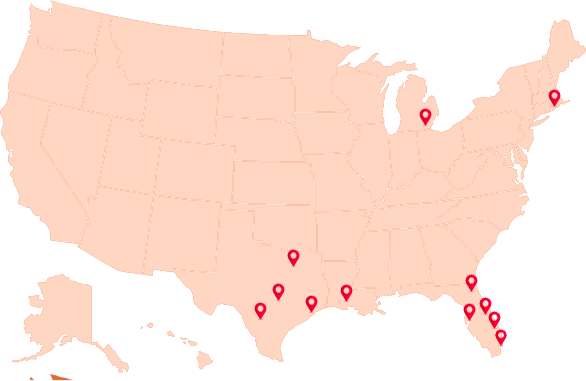
General personal injury or negligence deadlines in several states served by The Bed Bug Barrister include:
- Florida: Negligence actions are generally subject to a two-year limitations period under Florida Statutes § 95.11.
- Texas: Personal injury actions are generally subject to a two-year limitations period under Texas Civil Practice and Remedies Code § 16.003.
- Massachusetts: Personal injury tort actions generally must be commenced within three years under Massachusetts General Laws Chapter 260, § 2A.
- Michigan: Actions seeking damages for injuries to a person or property are generally subject to a three-year period under MCL § 600.5805.
- Louisiana: Louisiana now generally provides a two-year prescriptive period for delictual actions, effective for claims governed by the 2024 change; incidents occurring before the change may require separate analysis.
Cruise ship claims may be governed by passenger-ticket provisions requiring written notice and filing suit on a shorter schedule. Federal maritime law permits certain seagoing passenger contracts to establish a filing period as short as one year, making immediate review of the cruise ticket especially important.
These are general deadlines, not a determination of the deadline in any individual case. Exceptions, contractual terms, defendant identity, the date of injury, and the type of claim can all affect how much time remains.
How The Bed Bug Barrister Helps Preserve and Develop Evidence
Bed bug victims are often expected to investigate a sophisticated hotel operator, property management company, cruise line, or insurer while also dealing with injuries and contamination concerns. The Bed Bug Barrister takes on that investigative burden and evaluates whether the available evidence supports a viable claim.
Our legal team may help by:
- Organizing the exposure and treatment timeline
- Preserving photographs, communications, and physical evidence
- Sending evidence-preservation notices
- Investigating earlier complaints
- Seeking inspection and pest-control records
- Identifying the property owner, operator, and management company
- Reviewing medical documentation
- Locating witnesses
- Calculating financial and personal losses
- Handling communication with insurers and defendants
- Filing a lawsuit when appropriate
The Bed Bug Barrister is powered by RTRLAW, a personal injury firm founded in 1988 that has helped tens of thousands of clients secure hundreds of millions of dollars. That experience supports a legal practice focused specifically on the unusual evidentiary and liability challenges involved in bed bug injury claims.
Frequently Asked Questions About Bed Bug Claim Evidence
People often know they were bitten but remain unsure whether they collected enough proof to pursue a claim. The answers below address several of the most common concerns about documenting an infestation and resulting injuries.
Can I file a claim without a photograph of a live bed bug?
Possibly. Pest-control reports, incident records, staff statements, photographs of environmental signs, witness testimony, and other evidence may help establish an infestation even without a clear bug photograph.
The absence of a live-bug image makes the investigation more challenging, but it does not automatically end the claim. The entire body of available evidence must be reviewed.
Are pictures of bites enough to prove a case?
Usually not by themselves. Because bed bug bites can resemble other insect bites and skin conditions, photographs should be supported by environmental evidence, medical records, travel documentation, and a clear exposure timeline.
Bite photographs are still valuable, particularly when they show progression over time. Their value increases when they can be connected to reliable proof of an infestation at the property.
What if the hotel refuses to provide an incident report?
Send a written email summarizing what happened, when it was reported, and who received the complaint. Save screenshots and confirmation that the message was delivered.
A refusal does not erase the report you made. Your attorney may later seek internal records, employee testimony, or other documentation through formal legal procedures.
Should I keep infested luggage or clothing?
Do not discard valuable evidence before it has been thoroughly photographed and evaluated, but do not spread an infestation by moving contaminated items without proper containment. Follow professional pest-control guidance for safely isolating, inspecting, or treating the property.
In some situations, photographs and extermination records may preserve the necessary information without retaining every contaminated item. The appropriate approach depends on the severity and circumstances.
Can previous online reviews prove the property knew about bed bugs?
Reviews may help identify a pattern, earlier complainants, or dates worth investigating, but an online post alone is not always reliable or sufficient. Stronger notice evidence may come from internal complaints, pest-control invoices, employee testimony, and room-treatment records.
Save screenshots showing the review, username, date, and complete webpage context. Those details may help an attorney locate the reviewer or pursue corroborating records.
The amount of evidence required varies from one case to another. A legal review can determine whether the available materials collectively establish exposure, notice, causation, and damages.
Contact The Bed Bug Barrister for a Free Case Evaluation
You do not need perfect evidence before asking for legal guidance. What matters is preserving what remains and acting before records, witnesses, physical signs, or legal deadlines disappear.
If you suffered bed bug bites or other injuries at a hotel, resort, cruise ship, short-term rental, nursing home, workplace, or another property, contact The Bed Bug Barrister. Call (844) 404-1600 for a free case evaluation and learn what evidence may be available to support your claim.